CONTINUING THE REDUCTION OF THE FEDERAL BUREAUCRACY The White House March 14, 2025

FMCS Agency News

On March 14, 2025, the White House issued the following Executive Order.

By the authority vested in me as President by the Constitution and the laws of the United States of America, it is hereby ordered:

Section 1.  Purpose.  This order continues the reduction in the elements of the Federal bureaucracy that the President has determined are unnecessary.

Sec. 2.  Reducing the Scope of the Federal Bureaucracy.
(a)  Except as provided in subsection (b) of this section, the non-statutory components and functions of the following governmental entities shall be eliminated to the maximum extent consistent with applicable law, and such entities shall reduce the performance of their statutory functions and associated personnel to the minimum presence and function required by law:
(i)    the Federal Mediation and Conciliation Service;
(ii)   the United States Agency for Global Media;
(iii)  the Woodrow Wilson International Center for Scholars in the Smithsonian Institution;
(iv)   the Institute of Museum and Library Services;
(v)    the United States Interagency Council on Homelessness;
(vi)   the Community Development Financial Institutions Fund; and
(vii)  the Minority Business Development Agency.
(b)  Within 7 days of the date of this order, the head of each governmental entity listed in subsection (a) of this section shall submit a report to the Director of the Office of Management and Budget confirming full compliance with this order and explaining which components or functions of the governmental entity, if any, are statutorily required and to what extent.
(c)  In reviewing budget requests submitted by the governmental entities listed in subsection (a) of this section, the Director of the Office of Management and Budget or the head of any executive department or agency charged with reviewing grant requests by such entities shall, to the extent consistent with applicable law and except insofar as necessary to effectuate an expected termination, reject funding requests for such governmental entities to the extent they are inconsistent with this order.

 Sec. 3.  General Provisions.  (a)  Nothing in this order shall be construed to impair or otherwise affect:
(i)   the authority granted by law to an executive department, agency, or  the head thereof; or
(ii)  the functions of the Director of the Office of Management and Budget relating to budgetary, administrative, or legislative proposals.
(b)  This order shall be implemented consistent with applicable law and subject to the availability of appropriations.
(c)  This order is not intended to, and does not, create any right or benefit, substantive or procedural, enforceable at law or in equity by any party against the United States, its departments, agencies, or entities, its officers, employees, or agents, or any other person.

THE WHITE HOUSE,
March 14, 2025.

College of Labor and Employment Lawyers – STEPHEN E. TALLENT VIDEO HISTORY PROJECT

The College of Labor and Employment Lawyers—Stephen E. Talent Video Project has interviewed numerous key individuals who have impacted US Labor Relations history. These interviews include videos from four former FMCS Directors: William Usery, Kenneth Moffett, George Cohen, and Richard Giacolone. Click on this link for the page with all four interviews and many other interesting interviews.

Video History Project – CLEL (theclel.org)


Director and Two Future Directors Visit Newport News Shipbuilding

On May 17, 1996, Director John Calhoon Wells visited the largest unionized employer in Virginia,  Newport News Shipbuilding. He was accompanied by Charles Richard Barnes and Richard Giacolone, both of whom became future Senate-confirmed Directors of FMCS.


The 19th FMCS Director, Richard Giacolone, is far left in the picture. Director Wells (13th) is second from the left, and Director Barnes (14th) is second from the right.

Newport News Shipbuilding is a Huntington Ingalls Company and the exclusive builder of US Nuclear Aircraft Carriers. The aircraft carrier in the background of this photograph is the USS Truman CVN-75.

Newport News employs more than 20,000 people in the Hampton Roads region of Virginia. Three unions represent the majority of the shipyard’s employees, including the largest unit covering the trades employees: United Steelworkers of America, Local 8888, the International Union, Security, Police and Fire Professionals of America, Local 451, and IAFF I-45.

The Shipyard and the Unions have requested assistance from FMCS numerous times, including labor-management cooperation training and mediation assistance for all three collective bargaining agreements.

The shipyard and its three bargaining units have not had a work stoppage since 2000 due to many factors, including FMCS assistance.

FMCS Directors List

Directors of the Federal Mediation and Conciliation Service (with the date they took office listed and the President who made the appointment shown in parentheses), are as follows:  The Biden Administration did not have a confirmed  FMCS Director.

  1. Cyrus S. Ching (1947; Truman)
  2. David L. Cole (1952; Truman)
  3. Whitney P. McCoy (1953; Eisenhower)
  4. Joseph F. Finnegan (1955; Eisenhower)
  5. William E. Simkin (1961; Kennedy), the longest-serving Director, departing office in 1969
  6. J. Curtis Counts (1970; Nixon)
  7. William Usery, Jr. (1973; Nixon)
  8. James F. Scearce (1976; Ford)
  9. Wayne L. Horvitz (1977; Carter)
  10. Kenneth Moffett (1982; Reagan), served for seven months. (Never confirmed by the Senate)
  11. Kay McMurray (1982; Reagan)
  12. Bernard E. DeLury (1990; G. H. W. Bush)
  13. John Calhoun Wells (1993; Clinton)
  14. C. Richard Barnes (2000; Clinton)
  15. Peter J. Hurtgen (2002; G. W. Bush)
  16. Arthur F. Rosenfeld (2006; G. W. Bush)
  17. George H. Cohen (2009; Obama)
  18. Allison Beck (2014; Obama), the first woman to serve as director
  19. Richard Giacolone (2018; Donald J. Trump)
  20. No Director  (2021-2025; Joe Biden)

FRIENDS 2023 Meeting Phoenix, AZ

Friends of FMCS History Foundation Meeting 
Email sent to Friends mailing list

Not everyone knows that Roman Stoic Philosopher Lucius Annaeus Seneca is first credited with the adage: “Quality Over Quantity” in the first century AD, but that aptly describes the first reunion of retired and current mediators December 15th and 16th in Scottsdale, Arizona in many years.

Although small in number, the attendees brought their long experience, strong friendships, and mutual support for FMCS to bear as they renewed bonds and shared their vision for the future of the Agency.

In fact, a third of those who participated are still working full-time for the Agency. Participants traveled from both coasts and around the country to engage each other and build upon the trust forged through a love of mediation work, strong ties to FMCS, and shared experiences regarding our unique work in dispute resolution and conflict management.

Each recounted their individual narratives and what initially brought them the Agency. And, while every story had unique elements, shared features were easily identifiable throughout: a desire to assist parties in resolving their differences, utilizing skills they were born with and honed in myriad ways, and creating relationships that would draw from the parties’ contributions that would enable them to reach both personal and professional goals.

Javier Ramirez and Greg Goldstein both attended and expressed strong interest in exploring ways in which the “Friends of FMCS” group could support the Agency’s mission. Options included, but were not limited to, contributing position papers that might explore aspects pertinent to the Agency, helping to build and maintain the esprit de corps of mediators and support personnel emanating from our history, providing candid feedback as the Agency continues to evolve and adjust, all ranging from the impacts of the current Agency structure to mentoring opportunities.

The “Friends” party also had requests that would enable them to serve in various capacities, including an updated list of retirees, greater shared communications in anticipation of changes that would be helpful to the Agency, and appropriate occasions where “Friends” representation might be welcome, possibly at conferences, training, or other forums.

Ultimately, the participants saw this foundation meeting to be a success. And, while a larger attendance would undoubtedly have brought additional good ideas and diversity of opinions and perspectives, the very intimacy of the small group dynamic permitted participants to be deeply engaged with the ability to fully express themselves with fewer time constraints and greater openness as well as the chance to be more candid in expressing their ideas and reactions to others’ contributions.

The Board of Friends of FMCS History Foundation will continue to explore new ways to collaborate with the Agency and build upon this strong start as it plans its next steps to support both FMCS now and in the future and keep providing a place for retirees to remain viable and engaged in the process.
I have attached the FMCS meeting report to show the agency’s interest in continued collaboration. I have also attached a PowerPoint presentation that was used at the event (it also offers a memorial page for deceased former FMCS employees).
We once again are accepting donations to the Friends of FMCS History Foundation. You can send donations to Friends of FMCS History Foundation, PO Box 9517, Chesapeake, VA 23321. The donations will be used to pay non-profit fees, maintain the website, and, hopefully, the next Friends gathering.

Honorable Director Title

Where and how is the title Honorable used with high level Government Officials like FMCS Directors.

In the United States, government officials who have been elected to public office or are appointed by the President of the United States with the advice and consent of the Senate are afford the courtesy title of The Honorable. (US State Department Website)

Former director Kay McMurray #847 last resting place, reflects that honor.


Certification of Nomination and Senate Confirmation signed by the Secretary of State and the President  for the 19th Director of FMCS.


FMCS has 19 Directors according to the agency archives but depending on how you count, the number may be off by one.  Every Director, from # 1, Cryus Ching to #19, Richard Giacolone was nominated by the President and confirmed by the Senate with one exception.  One of the most visible and well known Directors in FMCS history was never confirmed by the Senate.

From the Reagan Library Archives:

Nomination of Kenneth E. Moffett To Be Director of the Federal Mediation and Conciliation Service

December 14, 1981

The President today announced his intention to nominate Kenneth E. Moffett to be Federal Mediation and Conciliation Director. He would succeed Wayne Horvitz.

Mr. Moffett has been Acting Director since January 1, 1981. He was appointed Deputy Director of the Federal Mediation and Conciliation Service in 1977. Previously he served as the Director of Mediation Services for 5 years. In 1969 Mr. Moffett was special assistant to former Director J. Curtis Counts. During this time, he was also named Executive Secretary of the Atomic Energy Labor-Management Relations Panel. Commissioned a mediator with FMCS in 1961, Mr. Moffett served in Washington, D.C., and in Cleveland, Ohio, for 5 years. In 1957-61 he was an international representative for District 50, United Mine Workers of America.

He graduated from the University of Maryland (1958). He resides in Adelphi, Md., with his three children. He was born September 11, 1931, in Lykens, Pa.

He received his recess appointment in December 1981.

Here is an article published by UPI after Director Moffett received his recess appointment:

Labor Secretary Raymond Donovan says the administration is continuing…

WASHINGTON — Labor Secretary Raymond Donovan says the administration is continuing to look for a permanent head of the federal mediation service despite the interim appointment of Democrat Kenneth Moffett.
Moffett, 50, who gained national attention last year through his role in mediating the professional baseball strike and contract talks involving the air traffic controllers, was sworn in Tuesday.

He was deputy director of the Federal Mediation and Conciliation Service from 1977 to 1981, when he became acting director on the resignation of Wayne Horvitz.

His nomination by President Reagan to head the service must be confirmed by the Senate. However, under the recess appointment while Congress was on its Christmas break, Moffett could remain as director until the end of the 97th Congress unless he resigns at the request of the president before then.

During an interview with four labor reporters, Donovan was asked about Moffett’s status and reports the administration is still interviewing others for the post.

‘By the fact that he was given an interim appointment would indicate that we are looking for talented people in that area, yes,’ Donovan said Wednesday. ‘Has that decision been made either on he, himself, or on another person? It has not.’

Asked if Moffett might remain in the position, Donovan replied, ‘In this town, anything is possible. Sure he’s a Democrat, but he’s a fine American and an exemplary leader of that agency and he has done yeoman work.’
Here is a Washington Post Article that reflects the situation for Director Moffett at the close of his career at FMCS.

Moffett Moves From Mediation to Advocacy

By Jane Leavy
December 26, 1982
His pal, Ken Moffett, had just been named the new executive director of the Major League Baseball Players Association. Jack Donlan, who is the owners’ man in football, sent him a telegram.”So you finally picked a side, albeit the wrong one,” it read. “No more circling the issues. Now you are one. The New York Road Runners are ready. Heinekens is diverting extra shipments from Washington to New York.”After 21 years at the Federal Mediation and Conciliation Service, 12 as a runner, two mediating baseball’s version of Love’s Labor Lost, Moffett was named earlier in the month to succeed Marvin J. Miller, the only executive director the association ever had. This is like replacing John L. Lewis. “Like Yaz following Ted Williams,” Moffett says.Moffett never could hit. Way back when, he was a lefty pitcher who once said, “My fast ball shoulda’ been arrested for loitering.”

Obviously, the player representatives and the members of the pension committee, who voted, 30-0, to confirm him, were impressed by Moffett. Many got to know him during the baseball negotiations and knew they could talk to him.

After the strike ended, they exchanged Christmas cards. Last winter, some of the players on the negotiating committee threw a party for Moffett and his general counsel, Nancy Broff. “They presented me with a plaque with a picture of all the people on the negotiating team,” Moffett said.

After the strike, they also presented him with a request. They wanted a list of six candidates who could replace Miller, who had decided to retire after 16 years with the union. Moffett did not submit his own name. “Someone he recommended was one of the top candidates,” said Mark Belanger, a member of the pension committee. “He could have recommended a dog.”

During the summer, Moffett said, a few players called asking if he’d be interested in the job. In August, Miller called at the behest of the players to ask him to consider placing himself in nomination. “I ducked it,” he said.

The situation at FMCS, where he had been acting director since January 1981 and director by recess appointment since January 1982, began to deteriorate. The Reagan administration, which had given him the appointment because it was legally necessary for him to carry out the RIFs they requested, selected Kay McMurray to become permanent director.

McMurray’s first action, Moffett said, was to fire Broff. “I’d be lying if I said that didn’t have a large bearing on my decision,” Moffett said. “It was a very upsetting thing for me. The way it was handled, I thought we both deserved better treatment. I don’t want it to sound like sour grapes, but we held that agency together with baling wire. We reduced the budget 25 percent over two years and the first thing they do is fire my lawyer because she was a Democrat.”

So, the attentions of the baseball players became increasingly enticing. “I was being seduced,” Moffett said.

When Moffett’s selection was announced, one of the first questions baseball people asked was how difficult it would be for him to make the transition from a neutral to an advocate. “No problem,” Moffett said. “Maybe they want someone who can figure out the puzzle how to avoid cataclysmic disputes. I’ve been doing it for 21 years.”

Donlan, who switched from FMCS to management, said, “The major difference is once an agreement is finished, the mediator walks away. The parties have to live with it. That’s where he’ll find the biggest change.”

One of the issues confronting him will be pending litigation over broadcast rights, whether the players have a “right to publicity”–that means the owners cannot negotiate with the networks without their consent. Also pending will be the conspiracy free agent hearing scheduled to go before an arbitrator next month. The players allege that the owners conspired to hold down salaries of the 1981-82 free agents.

Advocacy runs in Moffett’s family. His father was the president of the United Mine Workers, District 50, a 250,000-member union where Moffett got his start in 1958 as a field representative. That also was his last union job. His grandfather was a local president.

Belanger says the players concluded, “It’s impossible for someone in management to turn to labor but not that hard for a neutral to go to labor because a neutral, in my opinion, is usually for the employe.”

There was widespread feeling among management (usually expressed off the record) during the strike that Moffett was not as neutral as he should have been. Afterward, there were stories circulated and sometimes printed that he was campaigning for Miller’s job, which Moffett vehemently denied. At the time, friends say, he was quite happy running the agency.

Edward Bennett Williams, owner of the Orioles, said, “I don’t want to doom him by saying too many nice things about him.”

In many ways, Moffett is the logical successor to Miller, who, Moffett says, “did one of the best jobs in labor relations in the country during the last 16 years.”

Free agency is Miller’s monument. “I think it will be very difficult for anyone to follow in Marvin’s footsteps,” Broff said.

True, said Tom Donahue of the AFL-CIO, but “Moffett brings his own shoes, his jogging shoes, with him.”

Belanger sees important similarities between Moffett and Miller: rapport with players, the refusal to be impulsive, the willingness to listen.

Part of Moffett’s appeal was his credentials, contacts and administrative experience. Another part was the laconic, “who, me?” sense of humor that goes along with his aging (not aged) jock resume. He is a 10-kilometer man, whose greatest funk was recent surgery to remove bone spurs on his right heel. “That was one of the questions we asked,” Belanger said. ” ‘Why do you run?’ He said, ‘That’s my time. I’m alone. I think. I get organized. I care about my body and my appearance and I feel good.’ I thought it was a hell of an answer.”

The hardest part of the transition may be leaving Washington, his three children and his running partners. “He’s single, he’s a mover and shaker. He and New York should get along just fine,” said Donlan. “Of course, I’ll try to help.”

Back to the recess appointment discussion:

What Is the Purpose of a Recess Appointment?
The Constitution states that “[t]he President shall have Power to fill up all Vacancies that may
happen during the Recess of the Senate, by granting Commissions which shall expire at the End
of their next Session” (Article II, §2, clause 3). The records of debate at the Constitutional
Convention do not provide much evidence of the framers’ intentions in the Recess Appointment
Clause. A discussion of the clause by Alexander Hamilton, in The Federalist Papers, suggests
that its purpose was to provide an alternative method of appointment that would allow the filling
of vacancies “without delay” during periods of Senate absence. Opinions by later Attorneys
General also supported this general notion, suggesting that the purpose of the clause was to allow
the President to maintain the continuity of administrative government through the temporary
filling of offices during periods when the Senate was not in session, at which time his nominees
could not be considered or confirmed. This interpretation is supported by the fact that both
houses of Congress had relatively short sessions and long recesses during the country’s early
years. In fact, until the beginning of the 20th century, the Senate was, on average, in session less
than half the year. Throughout the history of the republic, Presidents have also sometimes used
the recess appointment power for political reasons. For example, recess appointments have
sometimes enabled the President to temporarily install an appointee who probably would not be
confirmed by the Senate.

In the authors humble opinion, even with the lack of Senate confirmation in Director Moffett’s nomination, his recess appointment is more than enough to continue to refer to him as the 10th Director in FMCS history.  Any other position would make every FMCS Director after 1981 a number minus one, former Director.


The Honorable 10th FMCS Director Kenneth Moffett.

Directors List 1-19          Badge Number

Director Ching #1                    28

Director Cole # 2                    242

Director McCoy #3                 136

Director Finnegan #4             328

Director Simkin #5                 413

Director Counts #6                 595

Director Usery #7                   658

Director Scearce #8               680

Director Horvitz #9                 797

Director Moffett #10               430

Director McMurray #11          847

Director DeLury #12              896

Director Wells #13                 927

Director Barnes #14              866

Director Hurtgen #15           1066

Director Rosenfeld #16        1105

Director Cohen #17              1124

Director Beck #18                 1126

Director Giacolone #19          953

Why are FMCS mediators called Commissioner?

FMCS mediators are called Commissioner because of the language in the Act that created the U.S Department of Labor in 1913.

That Act states in part:

“…. (T)he Secretary of Labor shall have the power to act as a mediator and to appoint commissioners of conciliation in labor disputes whenever in his judgement the interests of industrial peace may require it to be done …”

Therefore, from the beginning of the United States Conciliation Service (USCS) in the Department of Labor, staff members assigned to assist labor and management in resolving their collective bargaining disputes were called Commissioners of Conciliation.

In 1947 when FMCS replaced the USCS, the first Director of FMCS, Cyrus Ching, considered changing that title because he thought the title Commissioner would be off-putting for labor and management representatives, and therefore unhelpful in resolving labor management disputes.

When informed of the historic basis of the title, Ching did not attempt to make that change. However, he did change the title from conciliator to mediator since the latter had gained popular usage by 1947.

Cy Ching is shaking hands with new mediator Bill Rose

Director Ching presenting the 1951 version of the FMCS credential to Commissioner # 277 Bill Rose who was assigned to the Tampa, FL, Field Office.

While performing mediation, FMCS mediators will occasionally be addressed by the parties as Commissioner. But more often, they will be addressed simply as mediator.

Jim Elmore, a newly hired mediator in 1964, told fellow new mediator class members, including me, that when he proudly told his Irish father his new job title, his father responded: “That sounds like you’re the guy who runs the city water and sewer department.”

The photo above shows a wallet that mediators use for their official credentials. These badges were first issued in the year 2000 by Director Barnes and designed by Special Assistant Giacolone.  All active mediators at that time were issued this credential.  The response to the badge was mixed at that time but has become a tradition that is much treasured by Commissioners. Many retired mediators requested and were issued a badge with their number at cost.   In 2017 a decision by the place holder leaders of the Agency required all retiring mediators to return the badge.  That decision was not well received and eventually overturned under Director Giacolone’s tenure. Upon retirement all mediators receive a framed certificate of retirement which includes their Commissioner Badge.

Commissioner Brown Retirement Certificate

Commissioner Barry Brown # 936 receives his retirement certificate with the incorporated badge.

Note the word Commissioner and the number in the center. Each mediator from the beginning was assigned a number in sequence. When Jerry Barrett was hired in 1965, he was assigned the number 489. The number 723 was hired in 1970s and was issued to Eileen Hoffman.  Currently the badges are in the 1200’s.

History of FMCS Headquarters Locations

The FMCS National Office has been located at three locations in Washington, D.C., for its seventy-eight years of existence.

Initially, FMCS was located in the old Department of Labor Building at 14th and Constitution Ave NW, on the northeast corner of that intersection, very near the Washington Monument and a few blocks from the White House.

This building is part of the Historic Federal Triangle, constructed during the 1930s. See the map containing 12 buildings, including a few newer ones. The Triangle was created by the four streets surrounding it: E Street NW, Pennsylvania Ave. NW, 15th Street NW, and Constitutional Ave. NW.

In 1947, FMCS replaced the United States Conciliation Service (USCS) and took over the USCS office space, including the entire first floor, the Director’s office on the third floor (next to the Secretary of Labor’s Office), and space on the sixth floor for handling mail, copying, and storage. FMCS remained in the building for 29 years (1947 to 1976). At that time, the Labor Department (DoL) moved to a new, larger building near the Capitol. To emphasize the independence of FMCS from DoL, Director Bill Usery refused to move with DoL. Ironically, when the move to a new location occurred, Usery became Secretary of Labor.

In 1976, FMCS moved to a privately owned building at 21st and K Street NW. on the southwest corner of that intersection, a block from Pennsylvania Ave and a block from Washington Circle. The nine-story building included many windows, mesmerizing views, an attractive neighborhood, good AC, and underground parking. Initially, FMCS occupied all nine floors. However, over the years, as the agency’s size diminished, one floor at a time, it was given to another agency. By the fall of 2016, when FMCS moved out, FMCS occupied only 2/3s of the building. This location had the most prolonged occupancy for FMCS for forty years (1976 to 2016). During those years, thirteen individuals occupied the Director’s office on the ninth floor.

The building was demolished in March 2017, making way for a taller modern building. See the photo of a few bricks Jerry Barrett rescued from the demolition.


In late 2016, FMCS moved to its new location at 250 E St. SW, Independence Square, much closer to the Capitol. In January 2017, FMCS held several days of open house to showcase the new modern 21st-century office design, technology, and digital features that allow high-tech training, facilitation, and mediation. Nothing there resembles anything at the two previous locations. It is worth a visit.


FMCS occupies the seventh floor of 250 E Street.  The 2016 lease included the entire 7th floor, but due to the COVID pandemic and expanded telework, the Agency released a large percentage of the former leased space.  The building is connected to NASA Headquarters at Two Independence Square via a covered walkway.


Reception area for the Directors Office 250 E Street SW Washington DC

Directors Desk with a view of the U.S. Capital Building


How a Union Supported a Republican Nominee for FMCS Director

President Trump nominated Richard Giacolone as Director of the Federal Mediation and Conciliation Service (FMCS). Since his nomination, his confirmation has languished in the Senate until recently, when MTD President Hart and IAM President Martinez stepped in to support Mr. Giacolone.

MTD President Hart

“Mr. Giacolone served as the mediator of the Bath Iron Works strike and both President Martinez and I felt he was fair and acted in the best interest of all parties,” said MTD President Hart. “We wanted to support his nomination for Director of FMCS so we set out to move his confirmation forward.”

“After speaking to several Senate advisors, we were told that his confirmation hearing was unlikely due to the fact that his nomination had been held in the Senate for almost two years. Even if it were to be considered we were facing a time crunch with the Senate’s August recess,” explained Hart.

Knowing that the odds were against them and that they faced stringent timelines, Hart and Martinez both wrote letters of support and successfully asked AFL-CIO President Richard Trumka to do the same. After speaking with Trumka to explain why he too should support Mr. Giacolone, Hart reached out to Senate Minority Leader Charles Schumer, Senate Leader McConnell and Sen. Collins and urged them to also support the Acting Director and add his confirmation to the calendar.

In a surprising move, the Senate took up Mr. Giacolone’s nomination on August 13 confirming his appointment with unanimous consent.

“Richard Giacolone is a fair and equitable choice for the office of Director of the FMCS,” says Hart.

“The Metal Trades Department will work with Republicans or Democrat so long as they support the mission of America’s working families. I was proud to support Director Giacolone, and believe that he will continue to be an asset to the agency. Labor’s support helped ensure he was confirmed, but his work speaks for itself.”

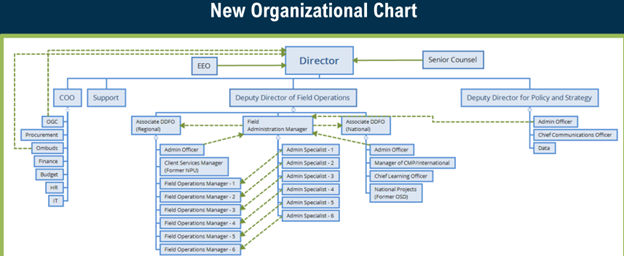
2022 FMCS Reorganization is Finalized

2022 Reorganization is Finalized

Acting Director

Greg Goldstein

Deputy Director

Javier Rameriz

Deputy Director for Policy and Strategy

Josh Flax

Associate Deputy Director of Field Operations National

Sarah Cudahy

Associate Deputy Director of Field Operations Regional

Beth Schindler

Client Services Manager

Kevin Buffington

Field Operations Managers

Region 1
Pete Donatello, Field Operations Manager
pdonatello@fmcs.gov

Region 2

Kathy Hall, Field Operations Manager
khall@fmcs.gov

Region 3
Tammy Poole, Field Operations Manager
tpoole@fmcs.gov
Region 4
Shane Davis, Field Operations Manager

Region 5
Walter Darr, Field Operations Manager
wdarr@fmcs.gov

Region 6

Jennifer Disotell, Field Operations Manager

jdisotell@fmcs.gov