Why are FMCS mediators called Commissioner?

FMCS mediators are called Commissioner because of the language in the Act that created the U.S Department of Labor in 1913.

That Act states in part:

“…. (T)he Secretary of Labor shall have the power to act as a mediator and to appoint commissioners of conciliation in labor disputes whenever in his judgement the interests of industrial peace may require it to be done …”

Therefore, from the beginning of the United States Conciliation Service (USCS) in the Department of Labor, staff members assigned to assist labor and management in resolving their collective bargaining disputes were called Commissioners of Conciliation.

In 1947 when FMCS replaced the USCS, the first Director of FMCS, Cyrus Ching, considered changing that title because he thought the title Commissioner would be off-putting for labor and management representatives, and therefore unhelpful in resolving labor management disputes.

When informed of the historic basis of the title, Ching did not attempt to make that change. However, he did change the title from conciliator to mediator since the latter had gained popular usage by 1947.

Cy Ching is shaking hands with new mediator Bill Rose

Director Ching presenting the 1951 version of the FMCS credential to Commissioner # 277 Bill Rose who was assigned to the Tampa, FL, Field Office.

While performing mediation, FMCS mediators will occasionally be addressed by the parties as Commissioner. But more often, they will be addressed simply as mediator.

Jim Elmore, a newly hired mediator in 1964, told fellow new mediator class members, including me, that when he proudly told his Irish father his new job title, his father responded: “That sounds like you’re the guy who runs the city water and sewer department.”

The photo above shows a wallet that mediators use for their official credentials. These badges were first issued in the year 2000 by Director Barnes and designed by Special Assistant Giacolone.  All active mediators at that time were issued this credential.  The response to the badge was mixed at that time but has become a tradition that is much treasured by Commissioners. Many retired mediators requested and were issued a badge with their number at cost.   In 2017 a decision by the place holder leaders of the Agency required all retiring mediators to return the badge.  That decision was not well received and eventually overturned under Director Giacolone’s tenure. Upon retirement all mediators receive a framed certificate of retirement which includes their Commissioner Badge.

Commissioner Brown Retirement Certificate

Commissioner Barry Brown # 936 receives his retirement certificate with the incorporated badge.

Note the word Commissioner and the number in the center. Each mediator from the beginning was assigned a number in sequence. When Jerry Barrett was hired in 1965, he was assigned the number 489. The number 723 was hired in 1970s and was issued to Eileen Hoffman.  Currently the badges are in the 1200’s.

History of FMCS Headquarters Locations

The FMCS National Office has been located at three locations in Washington, D.C., for its seventy-eight years of existence.

Initially, FMCS was located in the old Department of Labor Building at 14th and Constitution Ave NW, on the northeast corner of that intersection, very near the Washington Monument and a few blocks from the White House.

This building is part of the Historic Federal Triangle, constructed during the 1930s. See the map containing 12 buildings, including a few newer ones. The Triangle was created by the four streets surrounding it: E Street NW, Pennsylvania Ave. NW, 15th Street NW, and Constitutional Ave. NW.

In 1947, FMCS replaced the United States Conciliation Service (USCS) and took over the USCS office space, including the entire first floor, the Director’s office on the third floor (next to the Secretary of Labor’s Office), and space on the sixth floor for handling mail, copying, and storage. FMCS remained in the building for 29 years (1947 to 1976). At that time, the Labor Department (DoL) moved to a new, larger building near the Capitol. To emphasize the independence of FMCS from DoL, Director Bill Usery refused to move with DoL. Ironically, when the move to a new location occurred, Usery became Secretary of Labor.

In 1976, FMCS moved to a privately owned building at 21st and K Street NW. on the southwest corner of that intersection, a block from Pennsylvania Ave and a block from Washington Circle. The nine-story building included many windows, mesmerizing views, an attractive neighborhood, good AC, and underground parking. Initially, FMCS occupied all nine floors. However, over the years, as the agency’s size diminished, one floor at a time, it was given to another agency. By the fall of 2016, when FMCS moved out, FMCS occupied only 2/3s of the building. This location had the most prolonged occupancy for FMCS for forty years (1976 to 2016). During those years, thirteen individuals occupied the Director’s office on the ninth floor.

The building was demolished in March 2017, making way for a taller modern building. See the photo of a few bricks Jerry Barrett rescued from the demolition.


In late 2016, FMCS moved to its new location at 250 E St. SW, Independence Square, much closer to the Capitol. In January 2017, FMCS held several days of open house to showcase the new modern 21st-century office design, technology, and digital features that allow high-tech training, facilitation, and mediation. Nothing there resembles anything at the two previous locations. It is worth a visit.


FMCS occupies the seventh floor of 250 E Street.  The 2016 lease included the entire 7th floor, but due to the COVID pandemic and expanded telework, the Agency released a large percentage of the former leased space.  The building is connected to NASA Headquarters at Two Independence Square via a covered walkway.


Reception area for the Directors Office 250 E Street SW Washington DC

Directors Desk with a view of the U.S. Capital Building


From the Ranks to a Presidential Appointment as FMCS Director

Most FMCS Directors have been individuals appointed by the President from outside of government with experience in labor/management relations as advocates or neutrals. However, three Directors came from within FMCS and not directly from advocacy positions. These three individuals began their FMCS careers as mediators but then rose through the management ranks to receive a presidential nomination and appointment as FMCS Directors ultimately. Like other Directors, they had experience as advocates (Union for Moffett and Barnes and Management for Giacolone) before being hired as Commissioners at FMCS.

Kenneth Moffett

The first involved Kenneth Moffett, who had been a staff representative with District 50, UMWA, beginning in April 1958 before joining FMCS as a mediator intern in June 1961. Seven months later, he was transferred to Cleveland as a mediator—In 1967, he was appointed to the National Headquarters as a National Representative.

When Wayne Horvitz became Director in May 1977, he appointed Moffett as Deputy Director. Moffett remained Deputy Director until January 1, 1981, when Horvitz resigned to allow the new Reagan Administration to appoint a new Director. Moffett then became the FMCS Acting Director for the next twelve months. During that year, budget cuts caused a significant staff reduction. A suit initiated by several SES employees facing a RIF caused the Justice Department to determine that Moffett, as Acting Director, did not have RIF authority. In January 1982, the White House gave Moffett a recess appointment (which doesn’t require Senate confirmation) as Director so he could implement the RIF. Moffett’s tenure was dominated by a budget crisis requiring reorganization, eliminating 75 employees, and a shift to computerization. His tenure ended in July 1982, when President Reagan appointed Kay McMurray Director. Moffett had a distinguished career but was never confirmed by the Senate.  Director Moffett passed away in November of 2021.

Charles Richard Barnes

The second involves Charles Richard Barnes, who joined FMCS in 1987 following seventeen years as a representative for the Laborers International Union. He served as a mediator, District Director (1994) and Regional Director (1995) in Atlanta. Director John Wells appointed Barnes Deputy Director in 1996.  In 1999, he was appointed by Director Wells as Acting Director.  Then, President Clinton eventually nominated Barnes for the director position, and he was subsequently confirmed by the Senate and sworn in in  January 2020. He served briefly after the 2000 contested election until President Bush appointed Peter Hurtgen as his Director.

Richard Giacolone

The third was Richard Giacolone, who joined FMCS as a Commissioner in 1995 following 15 years as a management advocate. He was quickly promoted to Special Assistant to the Director (1998) and then Director of International and ADR Services (2000).  In 2004, he requested to return to the field as a Commissioner. He served the Mid-Atlantic region as a Senior Mediator until he was appointed by the President as Acting Director in 2018, then nominated and confirmed as the 19th Director by the U.S. Senate.  He mediated and resolved numerous major labor disputes, including the 2020 Bath Ironworks/IAM&AW strike. He is the second former mediator to be confirmed by the Senate.  He is the only FMCS Director appointed directly from a field Commissioner position by the President.


FMCS Mediator Interns and Other Untypical Hires

Traditional FMCS used its own hiring process separate from the Civil Service process that other Federal Agencies used, thus allowing FMCS to manage mediator hiring so as to fit the unique skill set required. For many years, new mediators were hired in groups based on minimum of seven years of labor-management experience at the GS-12 level.

Another more informal and less used practice existed in which less experienced individuals were hired who were viewed as having the potential to develop into a good mediator after an intern period of growth.

The following individuals were hired as interns or hired below the usual entry grade of GS12. They each would have their own unique hiring and training experience.

1. Herb Haber 195017. Nick Fidandis 196633. Lynda Myers 1994
2. David Tanzman 195018. Hal Davis 196834. Lynda Gonzalez 1994
3. Charlie Harding 195019. Jerry Ross 196835. Andrea Strimling 1996
4. Charlie Rehmus 195320. Ed Passman 1968
5. Paul Yager 195321. Nancy Fibish 1968
6. Jack Winter 195322. Bill Carr 1970
7. Ralph Fenton 195323. Jack George 1971
8. Ken Moffett 196124. Mike Nowakowski 1972
9. Tom Colosi 196225. D. Scot Blake 1972
10. Bob Callaway 196226. Gerry Gomez 1973
11. Jack Donlan 196327. Malcom Maples 1973
12. Ken Evans 196428. Ira Lobel 1974
13. Jerry Barrett 196429. Joel Roskow 1976
14. Bob Householder 196530. Pam Gentry (DeSimone) 1977
15. Bill Hobgood 196531. Ed Hartfield 1980
16. George Vogl 196632. Peter Swanson 1991

No further information was available from FMCS.

My intern experience in the National Office in 1964 was so unplanned and left to my own imitative that I was able to spend hours in Old Department of Labor Library[1] where I learned about the USCS and the early history of FMCS. When I was transferred to Milwaukee, I carried a box of history material that I had copied in the DOL Library. That boxful became the beginning of my collection now at George Washington University covering 136 shelve feet.

After five years in Milwaukee, I left FMCS to head an office in DOL for three years where my boss reported to Bill Usery. I did several things that got Bill’s attention, which I wrote about elsewhere. When Bill was appointed FMCS Director, he asked me to return to FMCS to head a new office of Technical Services. After he described the functions of the new office, he asked me if I had one thing I would like to accomplish at FMCS. I told Bill I would like to develop an intern program that would recruit, hire and train younger, minorities and female mediators.

Usery, always fond of new ideas, agreed. The result of that agreement was:

Two mediator intern classes in 1975.

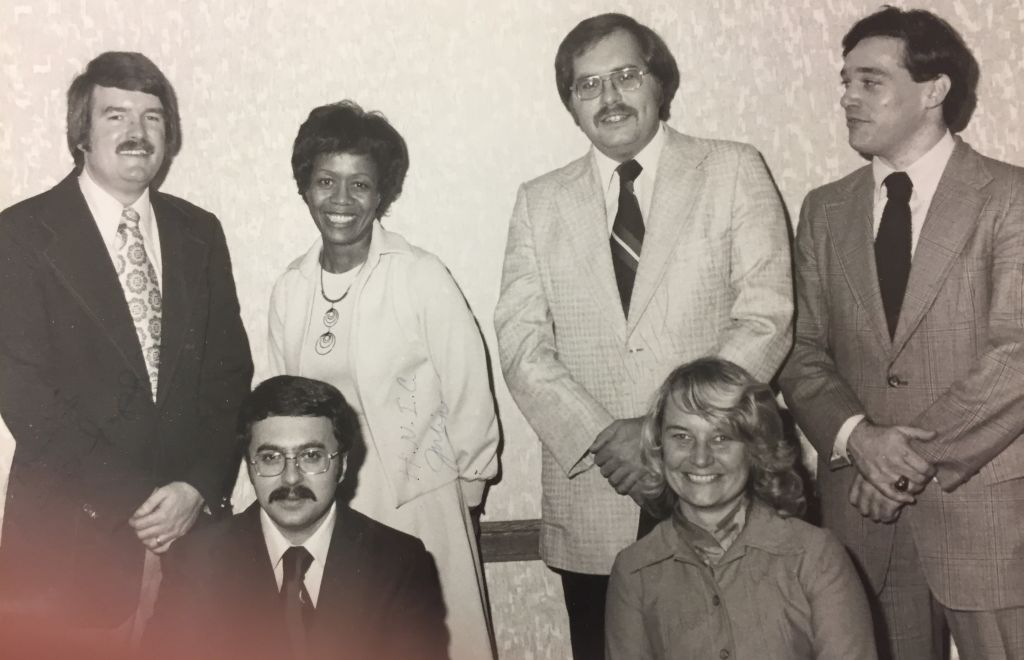
First Class: January 1975[2]

1st Row: George Buckingham (Became National Deputy Director), Bonnie Castrey (Left to became an arbitrator),

Ernie Bremer (not in photo)

2nd Row: Jim Schepker (Became a Manager in Chicago RO), Julie Greer (started mediation program for school kids),

John Knight (Served in numerous field offices), John Healy (Died young)

Second Class: July 1975[3]

1st Row: Eileen Hoffman (Became General Counsel and other N.O positions),  Bob Stiener (Served in several field and NO positions)

2nd Row: Jerry McKay (Left to become an arbitrator), John Steppe (Became Deputy Assistant Secretary in DOL),

 Chris Merchant (Wrote a book, became a professor)

3rd Row: Lois Vanderwaerdt (resigned), Mike Nowakowski (Long service in Detroit), Ron Sweet (Served in Milwaukee),

Doug Hammond (Manager in Seattle RO)

The case can be made that hiring five women mediator interns in 1975 opened the door for more women to join FMCS. Here is what happened:

Twenty-one years after its creation in 1947, FMCS hired the first women mediator in 1968. Ten women mediators were hired at normal entry level between 1975 and 1977. In the 1980s, twelve more women were hired, and in the 1990s, twenty-one more were hired.

By 2016, four of the ten FMCS Regional Offices were headed by a woman, the General Counsel and the Director were both women. In that year, twenty-eight percent of the 165 FMCS mediator staff were women.

In 2022 both Regional Directors (Beth Schindler and Carolyn Brommer), and three of the eight District Directors Linda Gonzalez, Jennifer Disotell, and Barbara Rumph) are female.


[1] At the time, the FMCS National Office was in the old DOL at 14th and Constitution NW.

[2] Oral history interviews recorded of George Buckingham, Bonnie Castrey, and John Knight by Jerry Barrett.

[3] Oral history interviews recorded of Eileen Hoffman, Chris Merchant, Bob Stiencer and John Stepp by Jerry Barrett.

FMCS and The Red Scare of the 1950s


[1]The expansion of the Soviet Union into Eastern Europe, the Berlin Blockade, and other aggressive actions including espionage following World War 11 caused fear and anxiety in the U.S.


Taking advantage of these conditions in the early 1950s, Senator Joseph McCarthy, as head of the Senate Permanent Investigating Committee, used hearings and investigations to accuse individuals primarily in State Department of being Red sympathizers. Frequently, his charges were without merit, but negative publicity alone caused great harm to individuals’ reputations and employment.

The House Un-American Activities Committee used similar tactics in Hollywood, which resulted in black listing individuals, and making them unemployable. In some cases, the charge might be based on nothing more that attending a meeting.

Motivated by the same impulse, the Eisenhower Administration issued a sweeping requirement that all federal employees in sensitive positions file an extensive security form. FMCS mediators occupied sensitive positions, and several mediators felt the impact of this.

The Saturday Evening Post published an article about the son of Regional Director Morrison Garst having Red sympathies. The publicity caused Garst to resign. Two other mediators, Henry Tucker and Leo Colten, both resigned rather than being exposed to a public hearing.

The most dramatic case involved mediator James McNamara. The February 6, 1954, Cincinnati Enquirer reported that James McNamara, former Federal Mediation Commissioner in Cincinnati, admitted to a Congressional Committee in Albany, NY that he was a communist.

James McNamara, born 12-29-1901, served five years as Business Agent for the Hotel Workers Union. He also worked four years as a newspaper reporter and feature editor. USCS hired him on January 30,1942, and he transferred to FMCS following the passage of the LMRA in 1947.

US trade unions have always had some curiosity about the USSR employment system. The Reuther brothers’ extended visit in USSR was based on that curiosity.

Since many mediators gained their experience in unions, it follows the some mediators had an interest or at least curiosity about Russia and communism.

Another example of the concern about communism in the labor movement is illustrated by the fact that the NLRA of 1947 originally had are a requirement that labor union officials were required to sign a document stating they were not communist before the Union could utilize any benefits of NLRA. At the time, there were a few communist leaning labor organizations. However, that NLRA requirement was later eliminated.


[1] Based on oral history interviews of James Greenword (1985) and Sorine Preli (1985) by Jerry Barrett

FMCS Director J. Curtis Counts (1969-1973)

FMCS Director J. Curtis Counts (1969-1973)

During college Curt Counts met and began dating the college roommate of Patricia Ryan, the future wife of Richard Nixon. During and after college and law school, the two couples frequently double dated, and kept in touch over the years.  During college at UCLA, Curt was known as a very good baseball player.

Prior to FMCS, Curt worked in the private sector as a manager for Douglas Aircraft Company with a focus on labor-management relations. In that position, he developed a sound relationship with IAM, the major union at Douglas. He would eventually become a corporate official.

Secretary of Labor George P. Shultz selected Counts in 1969 to serve as Director of FMCS. In making that announcement, Secretary Shultz reported that Curt was getting the job on his merits and experience, and not on his relations with the President.

Counts successfully served for nearly four years until 1973. He was able to develop a positive working relationship with Jimmy Hoffa, George Meany and Walter Reuther.

He resolved a three-month-long strike by the International Union of Electrical Worker against General Electric. He also was involved in settling a strike of the International Longshoremen’s Association and East Coast ports from Boston to Texas..

Counts interestingly aided the formation of the Society of Professionals in Dispute Resolution (SPIDR).[1] Based on his concern that the mediators were considering forming a union, he assigned senior mediator David Tanzman to travel to state and Canadian mediation services to determine their interest in forming a national organization of labor-management dispute resolver. Counts hoped that such an organization would shift mediator interest away from unionizing.[2]

Counts died at age 83 on June 30, 1999


[1] The predecessor to the Association of Conflict Resolution (ACR)

[2] Counts’ hope was met during his tenure, mediator unionizing efforts did occur periodically among the mediators.

The First Woman Mediator Hired by FMCS

In December 1968, Nancy C. Fibish was the first woman hired by FMCS since its creation in 1947. Her hiring ended a 21 year FMCS practice of hiring only men. The United States Conciliation Service (USCS), which FMCS replaced in 1947, had several women mediators who transferred to FMCS. Only one remained when Fibish was hired. Luckily, she was stationed in Chicago, and she retired two years after Fibish’s hiring. That was likely helpful for Fibish to have a woman mentor with a very similar personality.

Born April 24, 1934, Nancy Fibish earned a Bachelors degree in 1957, became a Fulbright Exchange student in France, and developed a strong French fluency. She worked as a social worker for several years, before spending three years (1960-1963) at University of Chicago working on a Masters Degree in Sociology and as a research assistant. In 1963, she worked again as a social worker until 1967

In April 1967, she was hired as an Intern by  the National Labor Relations Board in Chicago. She subsequently became a Field Examiner before leaving in November 1968 to join FMCS as a GS-12 mediator in Chicago. In 1970, she was transferred to the FMCS Field Office in Washington D.C.

In 1974, she was selected for a nine month Fellowship Program on Congressional Operations for Executives, sponsored by the Civil Service Commission and the American Political Science Association.

At the end of her fellowship in 1975, Nancy returned to FMCS and was assigned to the Mediation Office at FMCS Headquarters, where she assumed responsibility for administering the 1974 amendment to National Labor-Relations Act. That amendment added additional responsibility to FMCS for dealing with labor relations in the non profit health care industry.

In April 1980, she was detailed to the Office of Personnel Management. She returned to FMCS to accept an appointment as District Director for Cleveland in 1982.

In February 1983, she was separated by FMCS and transferred to the State Department’s Foreign Service. Her subsequent appointment as a Foreign Service Officer was confirmed by the Senate on May 1983. As a Foreign Service Officer, she served in Washington D.C., London and Belgrade, Serbia.

Following five years with the State Department, she became Executive Director of the Maine Public Employee Relations Board from October 3, 1988 to December 28, 1990.

In 2017, Marc P. Ayotte, the current Executive Director of the Maine Public Employee Relations Board, remembered Nancy as “an able administrator, focusing particularly on the agency’s mediation service.”

Nancy C. Fibish died in January 2002 at age 68.

FMCS Role in Regulatory Negotiated Rule Making (RegNeg)

Today, Regulatory Negotiations (RegNeg) are in common use at the State and Federal level helping agencies apply laws they are charged with enforcing. This was not the case forty years ago, before ADR use expanded into new dispute arenas.

Since statutory law lacks the detail necessary to provide for reasonable application and enforcement, government agencies charged with enforcing the law issued regulations or rules to fill in the gap. To make their rules, agencies invited public comment, and heard testimony in formal hearings. These proceedings tended to be very adversarial as each interest group attempted to secure a regulation most favorable to them. Following the written comments and testimony, the agency drafted regulations giving appropriate weight to the information offered by interest groups.

Nicholas Fidandis

In 1982, the Federal Aviation Administration was the first Federal government regulator to attempt to use RegNeg to establish a new rule. Federal Mediation and Conciliation Service (FMCS) mediator Nicholas Fidandis was asked to lead the rulemaking meetings. The issue involved a safety rule on maximum hours for pilots to remain on flight duty. The rule had not been changed in 30 years although equipment and practices had change significantly. Prior discussions and litigation had been unsuccessful in resolving the issue.

Seventeen groups were involved in meetings extending from fall 1982 to fall 1983. During the course of the meetings, several expectations had to be changed. The initial meetings were open to the public and media with a public transcript created of each meeting. When that proved unworkable because it prevented flexibility and candor, executive sessions were used, limited to the seventeen groups. Also the FAA Administrator expected that the meetings would produce recommendations, which he could use at his discretion in creating the new rule. When it became clear that the participants wanted assurance of more direct input, the Administrator was persuaded to accept the meeting outcome as the new rule. At the outset of the meeting, it was assumed that a consensus would be achieved among the participants. That proved unworkable because several groups could not publicly agree to a new rule for political and internal reasons.

Mediator Fidandis was aided by the participants’ recognition that a less acceptable rule would be imposed if they didn’t work together to fashion a new rule. With input from the parties, the mediator wrote a rule that the majority of the participants endorsed. The FAA Administrator issued that rule in the spring of 1984.

The process developed by this initial and successful RegNeg became the model for subsequent rulemaking efforts. Since 1984, FMCS mediators have participated in dozens of RegNeg cases at the Federal and State level.

Based on several years of RegNeg practice, the American Bar Association and others recommended that Congress enact the Negotiated Rule Making Act in 1990. The Act’s purpose was “to encourage agencies to use negotiated rulemaking when it enhances the informal rulemaking process.” FMCS is identified in the Act as a provider of RegNeg assistance.

The Act was reauthorized in 1996 and is now incorporated into the Administrative Procedure Act. A number of States have implemented processes similar to the Federal arrangement. Many government regulatory agencies have used the RegNeg process to their satisfaction and that of interested parties.

Union General Howard Founder of Employment Arbitration

Union General Oliver Otis Howard fought at Gettysburg, Chancellorsville, Antietam, Peninsula Campaign, Chattanooga, Atlanta and the Carolinas. He lost an arm at the Battle of Fair Oaks in Virginia, and received a Medal of Honor. He would subsequently become Founder of Howard University in Washington D.C., Superintendent of the Military Academy at West Point, and author of a number of  books and papers.

Immediately after the Civil War ended, General Howard became Chief Commissioner of the Freedmen’s Bureau with staff members throughout the Southern States providing education and other assistance to former slaves including their new employment arrangements.

During a staff briefing, Howard learned from an aid that field staff was being overwhelmed by requests to resolve disputes between former slaves and former slave owners regarding future employment. Former owners needed workers to operate their business or farm. The former slaves were available since, in most cases, they were still living where they had under slavery.

Here is a discussion between several aids and Howard:

Howard: I assume former slaves are reluctant to move from where they have spent their entire lives working and raising their families. They lack life experience beyond that little plot of land.

Aid: Yes. But, while they lack worldly skills, they have the skills their former owners needs.

Howard: That suggests a perfect arrangement. An employer needing employees and skilled employees on the premises.

Aid: Yes. If only they could agree on what the new working and living conditions should be. It is a difficult transition from being a slave to a freeman. Difficult on both sides, with many questions to decide. Will a former slave and his family be paid and how much? Will they be charged for their housing and food, such as it is? We certainly don’t have the answers, but they are looking to us to solve their problem.

Howard: Those are very difficult questions. We need someone as wise as King Solomon to resolve such disputes. From the Bible I know Solomon could handle difficult problems. What about a King Solomon-like arrangement in which a wise individual would listen to both sides and then decides what is fair and just? I wonder if someone from the Bureau could do that?

Aid: Since we are in a certain position of authority, and, after all, the parties, or at least the former owners, have come to the Bureau for help. Maybe the Bureau could decide the issues.

Howard: The problem will be getting the parties to accept the Bureau decision. They might be more willing to accept the process if each side had someone to help the Bureau make the decision.

Aid: The Bureau representative would be the head arbitrator, if we can use that word. And each party could designate their own arbitrator to join our arbitrator in making the decision on what is fair and just.

Howard: I believe such a process should be tried on a few cases. Test it out. See what reaction we get. I think I will act as arbitrator on the first few cases to get it off to a good start. Would you arrange that?

Aid: Yes sir. I’ll make the arrangements.

Howard’s process is probably the earliest example of resolving disputes between workers and employers. By the beginning of the 20th century, government began encouraging such a practice, and by the mid 20th century, grievance arbitration was a widely use process for resolving disputes arising in collective bargaining agreements.

Early Alternative Dispute Resolution

[1]Two men glare at each other. Long-haired and bearded, their garments oily from use, they hold gnarled clubs loosely at their sides. Emotions have been building since the rainy season started and the river overflowed. Who will be forced to brave the swollen river to hunt, and who will hunt near their village? Today it will be decided. With war cries, the disputants raise their clubs and begin to circle.

Suddenly an old man appears, shouting “Behold, the Deciding Stone!” The two men stop in midstride. The old man says, “Ush, the smooth side is yours; Ore, the rough side is yours.” The pair hesitate, looking angrily at each other and at the old man, and finally they nod in agreement.

With all his might, the old man throws the stone into the air. Their heads turn to the sky as they watch the stone turn over and over.

This imaged story of prehistoric times illustrates that while humans have always had the tendency to solve their differences by fighting, they also have recognized the benefits of settling matters peacefully by flipping a coin or some other peaceful way. This search for alternatives to violence is a precursor to today’s alternative dispute resolution (ADR).

[1] This fictional story is from A History of Alternative Dispute Resolution: The Story of a Political, Cultural, and Social Movement by Jerome T. Barrett. (2004 Jossey-Bass)